Emil Fuchs: The Fan Who Bought a Big League Team
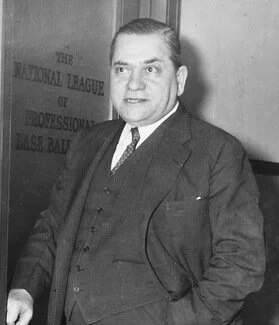
Attorney Emil Fuchs, who bought the Boston Braves in 1922. Photo credits: Wikipedia
How many baseball fans, sitting in the bleachers, have dreamt of owning a big league club, hiring managers and making player trades, hobnobbing with the rich and famous of the sports world?
For one such fan, the dream came true, though in the end it cost him everything he owned.
Emil Fuchs was born in Hamburg, Germany, in 1878. He was still a youngster when his family emigrated to New York. Like many such boys, he fell in love with baseball and became an enthusiastic Giants fan as part of his Americanization.
He went to law school, became a successful attorney, (He served briefly as a judge in Brooklyn and thereafter preferred to be known as Judge Fuchs) and mingled with Broadway’s sporting crowd, which included Giants manager John McGraw. This friendship led to his representing the Giants and McGraw in legal matters.
In the 1920s the two teams in Boston were impoverished second division dwellers. The National League Braves were for sale. John McGraw suggested that Judge Fuchs buy the team. He did, in 1922, along with former Giants star Christy Mathewson, who would provide the baseball experience. But Matty soon had to resign; he was dying from his World War I gassing.
From the start Judge Fuchs was a fans’ owner. He lowered ticket prices for many sections of Braves Field. He changed Ladies’ Days from Friday to Saturday to accommodate working women. In those days the stock market was open until noon on Saturdays; he moved Saturday game times from three to two o’clock so brokers and their customers could go to the games without going home first.
But year after year the Braves continued to lose more games than they won. In 1928 Fuchs surprised the baseball world by trading for six-time batting champion Rogers Hornsby from the Giants and installing him as the manager. Hornsby led the league in batting for the last time, but the Braves lost 103 games and finished last again.
Under ancient Puritan laws, professional sports were banned on Sundays in Massachusetts. When a measure to repeal the ban made it to the November 1928 ballot, Judge Fuchs was out in front, pouring $200,000 of his own money into the campaign. The measure passed; Braves attendance doubled in 1929, a quarter of it coming on Sundays.
Fuchs recovered the $200,000 by selling Hornsby to the Cubs for that amount plus a couple of players. Then, figuring he could save some money and do no worse, he decided to manage the team himself. He hired a couple of veteran coaches, Hank Gowdy and Johnny Evers, to do most of the managing while he sat on the bench in street clothes; the Braves finished last again, but improved to only 98 losses.
The judge had enough of managing and hired an experienced manager, Bill McKechnie, in 1930. The Braves finally rose to break even in 1932 and become contenders in ’33 before finishing fourth with an 83-71 record. But the Depression was worsening and the judge was losing money every year.
He took on a partner, offered two-for-one deals for Sunday doubleheaders and cut prices on more seats. In an effort to find more revenue, he appealed to the league for permission to build a dog racing track around the perimeter of Braves Field for night races, but was turned down because the major leagues wanted nothing to do with anything involving gambling.
When the Yankees were ready to cut Babe Ruth loose in 1935, he signed Ruth using the bait of a possible managing job, but after a month of playing and coaching, Ruth retired.
Unable to pay the $40,00 rent for the ballpark, which was still owned by the estate of the former Braves owner, Judge Fuchs sold his interest in the Braves to his partner in 1935. He died in Boston in 1961, a fan to the end.
