Dazzy Vance: Unlikely Hall of Famer
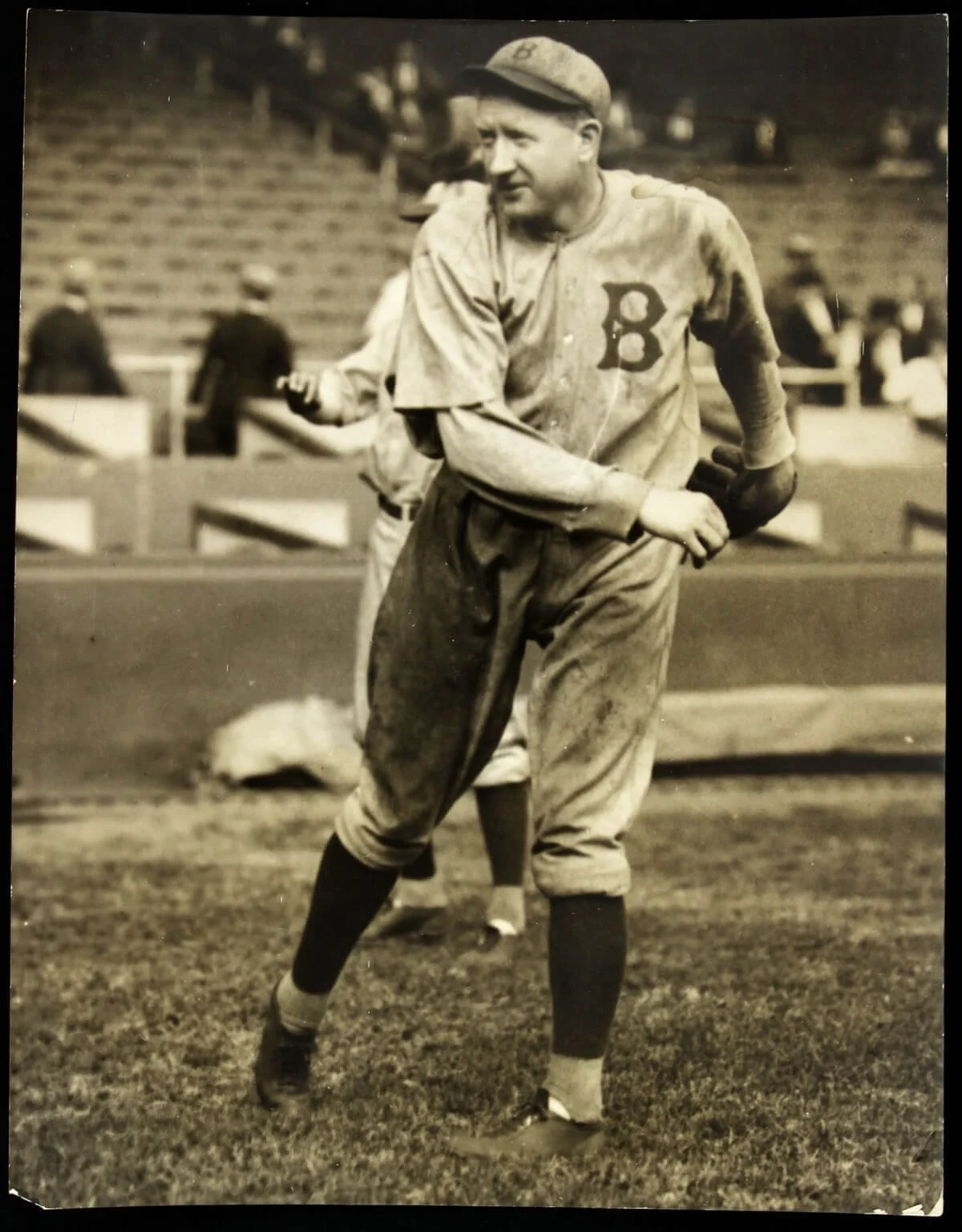
Image credits: Mearson Online Sports Auctions
You might call this a story about a double play. But it's not Tinker to Evers to Chance. It's more like bone chip to poker chip to Hall of Fame.
Born in Iowa, Arthur Charles Vance (or Charles Arthur Vance; he apparently changed it at some point.) Doesn't matter. From the time he was a 6-2, 200-pound teenager who threw dazzling lightning bolts, he was known only as Dazzy Vance for the rest of his life.
As an amateur and semi-pro pitcher he was a workhorse, once pitching four games in six days in 1914. Somewhere along the line he noticed that his arm ached for days after each time he pitched.
He still had dazzling speed and threw a low sweeping curve, but when his arm hurt he became unreliable. He wandered among the minor leagues, not lasting long with anyone. His fastball earned him brief trials with the Pirates and Yankees, but he impressed nobody.
A gregarious redhead, he made friends easily and was always among the fun-seekers wherever he landed. He pitched for so many teams that, when he finally reached the big leagues, he claimed that he could join any team and find at least three former teammates or opponents.
The story of how that eventually happened begins when he was with the New Orleans team in 1920. Playing poker one night with teammates, he won a big pot. While joyfully raking in his winnings, he banged his right arm on the edge of the table.
When the arm still hurt the next morning, he went to a doctor, who diagnosed a chronic problem in his arm. Perhaps it was bone chips in his elbow. Perhaps it was what later led to what's become known as Tommy John surgery. Whatever the doc fixed or removed, it cured Dazzy Vance's arm problems.
In 1921 Vance won 21 games for New Orleans. His regular catcher was Hank DeBerry. After the season the Brooklyn Robins made an offer to buy DeBerry, who said he wouldn't go unless Vance went with him. Brooklyn owner Charles Ebbets knew Vance's history and wasn't interested in “another sore-armed pitcher,” especially one who was already 31. But his scout persuaded Ebbets that Vance was healthy and the deal was made.
And that's how Dazzy Vance got to the Hall of Fame.
Dazzy Vance in Brooklyn
Relying primarily on his fastball and a low sweeping curve, Vance led the National League in strikeouts for seven straight years.
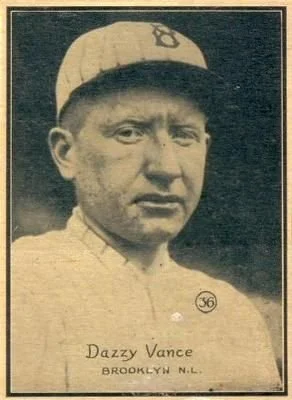
Dazzy’s stint in Brooklyn secured him a place in the Hall of Fame. Image credits: TCDB
In 1924 he almost single-handedly pitched the usually second-division Robins to a second-place finish, only 1.5 games behind the pennant-winning Giants, earning MVP honors with a 28-6 record, 262 strikeouts and a 2.16 ERA.
In the year of the hitters – 1930 – the league ERA was 4.97; The 39-year-old Vance's was a league-leading 2.65.
Dick Bartell
What was it like to bat against Dazzy Vance? Dick Bartell was a rookie with the Pittsburgh Pirates in 1928.
“We were in Brooklyn for a Sunday doubleheader on July 22. I was a sub infielder, hadn't started a game yet. But our regular shortstop was having arm problems. After the first game the manager said to me, ‘You're starting the second game.’
I went out to watch the Brooklyn pitcher warm up. It was 37-year-old Dazzy Vance.
Vance wore a long-sleeved undershirt with a shredded, flapping sleeve on his right arm that made it hard for the batter to concentrate on the ball when it seemed that, just as he let it go, he was waving pieces of rag carpet in their faces.
Later they passed a rule banning ragged sleeves. But he didn't really need it. He had the best stuff of any pitcher in the league: a fast ball he would shoot right under your chin for openers and an overhand curve that rolled off a table. He was on his way to leading the league in strikeouts for the seventh straight year, – and I helped him.
My first time up, I struck out. I choked up on the bat the next time I faced him and he struck me out again.
So I choked up a little more the next time at bat, just trying to meet the ball, and he fanned me again. The last time up I choked up so much on the bat you couldn't tell which end I was holding. I still didn't hit him.”
Traded to the St. Louis Cardinals in 1933, Vance made a brief appearance in the 1934 World Series at the age of 43. He ended his career back in Brooklyn in 1935 and finished with a 197-140 record. Vance was elected to the Hall of Fame in 1955.
Vance had fallen in love with Florida on his first spring training in the state. He made his home in Homosassa Springs, north of Tampa, where he enjoyed fishing and hunting and moonshine, and died there in 1961.
